Showing posts with label Teacher Stuff. Show all posts

May 17, 2023

Simple and Practical Teacher Gift

I've been given a lot of thoughtful teacher gifts over the years. The mug I'm drinking my coffee out of right now was from a  student named Bristyl in 2011. I still use it almost every day. 

(Bristyl/Bristol is one of those classic Alaska names that I always had on a short list for a baby girl...I didn't remember until after Sutton was born that Sutton is also the name of a town in Alaska.)

In this day and age, if you don't own a high-tech, high-powered color printer and a Cricut, you may feel like teacher gifts are hard. No. Those things are cute and always appreciated. But practical is great too. 

I prefer the Simple Modern tumbler because it really is practically leakproof. It has to really get thrown around (usually by a small uncoordinated child) in order for anything to come out. Usually it comes out through the straw if it ends up upside down (which it has). 


I got this 16 oz one for Wells' teacher in a super pretty color and then I added a summery tea mix and a packet of iced coffee mixes. 

It may not seem like over the top or incredibly thoughtful, but a quality mug or tumbler goes a LONG way for a teacher. I used a Starbucks travel mug from a student for many years. I remember his mom asking me if I preferred hot chocolate or coffee and she gave me an assortment with the mug for Christmas. 

I had a student give me a large ceramic birdhouse shaped like an apple once. It says "To Miss Twigg, Love Sylvia, 2008". Very thoughtful. We've now been moving it around for many years. Another made me a rainbow striped wooden birdhouse and I hung it outside on the one tree here and it was battered to pieces in a summer storm a few years ago. 

Anyway. Teacher gifts. Something they can use immediately is always the best bet. Letters, drawings, paintings are great too. I have several that I've actually framed over the years and have them used them as classroom decorations. 

Evidence of learning is great to include too!


September 13, 2021

A story about teaching

Teaching is incredibly different in 2021 than it was in 2010 when I started. Technically, I started in 2008, as a student teacher and then subbed the 2008-2009 and 2009-2010 school years, in Pennsylvania and Alaska, respectively. 

When I got my first job in Alaska for the fall of 2010, the teacher I ended up working most closely with was a veteran teacher. She'd been teaching for over 40 years at that point and wasn't slowing down any time soon. I taught there for 3 years, and we moved away in 2013.

In February 2020, I got a phone call from another teacher friend in Alaska, saying that this teacher had passed away. I was devastated. Mostly because it was the middle of the school year and how awful and I knew how absolutely ticked she would be, knowing she'd not be going back to school. 

Secondly, I had never made it back to Alaska to see her again. 

There was a moment back in 2018 where we were thinking of going back to Anchorage for 18 months for Scott's Corps of Engineers job. I had always thought how great it would've been to take Wells up to meet her and everyone else I had worked with. We'd ended up going to Pittsburgh instead.

She and I had talked on the phone a few times a year since 2013 and shared emails.

It wasn't until I read her obituary in February of 2020 that I realized she had been born in Laramie, Wyoming. There is one hospital there. If she was born in a hospital, it was the same hospital where Wells had been born. The world isn't small enough for a coincidence that big. 

I knew her family was from southeast Alaska and they'd hopped around from Juneau to Valdez to Kenai and I knew she'd gone to college in Oregon and had hated it because it was "too hot" and got a sunburn for the very first time. I knew her first teaching job had been on the Kenai Peninsula and the giant earthquake of 1964 had literally rocked her family's world with her friends dying and her dad *almost* dying in the tsunami at Valdez. He was the only one smart enough, she said, to realize what was happening when the water went out and ran for higher ground. Everyone else on the docks was washed away. 

And, a fun fact that would be absolutely unheard of today: When she had both of her children, she took less than a week off from school. In the case of her son, she "had him on Monday and was back by Thursday". I think my jaw dropped at that. She was not a snowflake, union-protected teacher of today. She'd make Randi Weingarten cry. Our district had well over 1,000 certified staff; she was listed as the one with the most seniority. 

As February 2020 dragged into March and that slooooowly dragged into April and May, I realized that she was taken home to Jesus at exactly the right time. This was not a coincidence. Virtual school? Zoom classes? Forcing your students to wear masks all day and not touch each other on the playground? 

This was not her world. It's not really of my world either. 

I don't like everything we're doing. I don't agree with it. I don't see how it's "helping kids grow and learn". But I am a unique mix experienced enough to use what I already know and young enough to maybe stick it out. 

This teacher in Alaska always told me that if I stuck it out long enough, I'd see the cyclical nature of education...everything comes back around again. Open classrooms (1970s) turned into the flexible seating of 2018, for example. Math practices that were outdated in 2000 are coming back 20 years later. There is nothing new under the sun. 

She also told me not to quit (and I have multiple times!) because I was a good teacher. I swear this is why I keep trying to go back. Knowing she thought I was a good teacher means a lot but, I'm pretty sure, it took me the entire 2010-2011 school year to win her good graces and then she realized I was more like her (at my inexperienced 24 years of age) than I was not like her, when it really came down to it. 

So part of me feels like if I stick it out, I will see this all come to an end and school will return to the way it was intended to be. 

What makes me feel awful is that there are young teachers out there who have never known what teaching is actually supposed to be like. They think teaching is 100% "social-emotional"-based (because of the HORRIBLE mental health issues that have been created in the last 2 years), they have never been on a field trip, and they'll never be able to have regular old class parties or assemblies. None of this is changing any time soon.

While sometimes I feel very old in my field, if I didn't have my experiences to fall back on, I wouldn't be doing this right now. I worry about not only the kids who are the real victims here, but the brand-new teachers who won't have prior experiences to keep them going. 

This pic is 10 years old so the kids are unrecognizable. It's a screenshot from a movie I have saved. I just wanted to share that I used to do really fun things. This class got so into a reader's theater we did that I assigned parts and let them create a set and put it on as a play for another class and for their parents. This is would never happen today. Parents aren't even allowed in our buildings anymore.

March 31, 2020

Homeschooling?

I didn't even know what to title this post.

His first coloring book. 
He just likes looking at the pictures. 
He doesn't get "coloring" yet. I tried. 


We could also go with the title "NO ONE HAS ANY IDEA WHAT THEY'RE DOING RIGHT NOW SO JUST DO SOMETHING".

First, the idea of homeschooling my child long-term is a special kind of nightmare for me.

I have nothing but respect for parents who choose to homeschool. That is AWESOME. Good for you. GREAT for you. I just know it's absolutely not for me.

I've always stood by two things:

1. I always said I could/would homeschool our children if I had to. If we lived in a particularly undesirable school system for a short amount of time, or if we were moving at weird points in the school year; I wouldn't register a kid in a new school in April or May, if that's when we were moving to a new location. I'd likely keep him at home and just start over in the fall. There's a lot of variables that go into those situations and decisions, so that's just my framework and starting point on the topic.

2. The other thing is that I don't want to be my child's only teacher. I could teach him, sure. I just loved my students over eight years so much that I couldn't imagine not having them as part of my life experience. I want my child to have that too. I know there's a lot out there about schools not being good enough or public education being awful. But I still believe in it. I would send Wells to a private school in a heartbeat, if that was our best option. But I want him to be part of a school because being part of a school for these last however many years has been a huge part of my life experience.

So.
With that out of the way...here's my thoughts on what's happening now...

You've seen a lot of fallout over the last few weeks concerning how the government just cannot get their act together. You know who was able to make this transition as seamless and tactful as possible?

Teachers.


Platitudes aside, being a teacher in the last two weeks had to have been rough.

But for all the kids who are now at home, I have thoughts...

If you have kids you homeschool by choice, awesome. Seriously. I couldn't do it. Or rather, I would likely choose not to do things that way because I know myself. I've never had an opinion on homeschooling (except for what I listed at the beginning of this post), to be honest.

But now, I see things like this and I get defensive and upset:


I like public school. I liked being a public school teacher. I think it is a wonderful place of community and belonging. As I've said before, my best memories are of my experiences as a teacher. Not every day was good and some days it was really hard. I have cried at my desk and to my coworkers before. I have dreaded getting out of my car in the morning. It's not glamorous in the least but there is no other job I'd rather do, professionally.

For what it's worth: I don't think the kids will be particularly behind by missing the last 2-3 months of the school year. See the end of this post for my reason. 

I think teachers should have more individual say in their classrooms and I think mandated testing should go away and, if the last two weeks have proven anything, it's that teachers should be in charge because things would get done a lot more efficiently.

And then I see words like "indoctrination" being thrown around and I have to think: I've had hundreds of students, maybe more..how many have I indoctrinated? My answer to that would probably be none. I was always very careful to never let my opinion about serious topics come out because what I thought didn't actually matter.

Kids knew that I liked dogs more than cats and that backpacks and coats on the floor was a no-no and that I ate a lot of candy and that I didn't like the color red. They had no idea about my political beliefs.

Because I didn't talk about them. That wasn't my job.

In fact...and this is where I must disclaim that I didn't vote for Donald Trump in 2016...I remember a student being mad that Donald Trump won in November that year because her mom was mad. She said something..I don't even remember what but I remember exactly where she was sitting and lamenting as she said it...and I said I understand what it's like when someone you want to win doesn't win. Remember how we watched the BrainPop video about elections? And we read about how the President is elected? That's what happened. Every time a President is elected, half the country is upset and someday you'll be able to vote and help make a difference. This is how the U.S. government was set up, just like we talked about. 

Or something like that. Facts and details, not opinions, has always been my philosophy of teaching. Kids don't need to know their teacher's opinion on every little thing. (But it was always important that they knew red decorations did not hang on our classroom walls because I really don't like primary colors.)

And, to push this along even further...because we're all socially distanced from each other, so why not?
Sometimes I feel like the fact that I believe in public schools means I need to hand over my conservative Christian card.
Like I can't be politically conservative if I think public schools are okay. And I can't be a truly biblical version of a Christian (you know, not like a Rachel Hollis or Beth Moore or Glennon Doyle version) if I believe public schooling is an option.

That's just something I've been thinking about a lot lately. ^

Circling back to what I originally wanted this post to be about..

If you are homeschooling right now because your child's school is closed...
If you are homeschooling right now because your child's school is closed and you also have to work from home at the same time with no extra help because of social distancing...
And if you, God bless you, are going to work and your child must also be homeschooled and you need to figure out how to do childcare AND schooling while you're not at home...

In all of these situations, I can recommend a few things:


  • Your child does not need 78 sets of manipulatives. 
  • You do not need to run out and buy a color laser printer and laminator.
  • Give daily quiet time with books and snacks.
  • Legos, K'nex, race tracks...anything that can be built qualifies as STEM. Promise. 
  • Workbooks are great! Coloring books and activity books are good too.
  • TV is fine. Especially anything that helps them learn...I can recommend some of the educational series I used in my classroom for indoor recess or end-of-the-day viewing if you need ideas!
  • Educational video games are a perfectly fine use of time. 
  • Outdoor playtime is ideal.
  • Schedules are hard*, especially when a new normal feels anything but normal. 
  • Read aloud!!! 
Much of what happens in an actual school is about management and schedules and meeting minutes for state guidelines. School does not take 8 hours a day. Think of it like a tighter version of summer vacation maybe?  Plus...and this is kind of a dirty little secret...most of the actual necessary material that needs to be covered is covered between September and March. State testing is in April and then it's a free-for-all until June. Your kid won't be behind.


*I love having Wells on a schedule. It does not work out every day, no matter how hard I try. I loved having my classroom run on a schedule. Schedules are overrated though. It's necessary in a school, but you live and die by your schedule out of that necessity. I spent all of my days looking at the clock and making sure I was doing everything that needed to be done in the allotted time. It's HARD. Please don't do that to yourself if you're suddenly home with your children. Keep it flexible. It actually hurts when I see moms put 3 year olds on a school schedule. We all know you're doing the best you possibly can. I don't believe any mom or dad is trying to drop the ball on education during this weird time. 

June 5, 2018

March/April/May: What to do in the classroom


The end of one school year is the perfect time to figure out what you want to work for the next year. You can try out new systems, techniques, and routines, just to get a feel for how they work with an actual group of kids you already know. Starting with something new for you, with a new group of kids in August, is stressful and unfamiliar. For example, flexible seating. You want to try it out before you introduce it as "the way we'll do things" because you could end up hating it or you could see some major or minor tweaks that need to be made right away.

Here's a few of my go-to activities for the end of the year...

24 March Madness Bracket
Every year, I teach the kids how to play 24 and let them practice for part of math most days. It's a great center activity. We practice in January, February, and March and then, in April, I run a one or two day challenge with a bracket and the winner gets their own set of 24 cards. It always goes that most of the class will really enjoy this, especially those higher-level math kids. I always make it optional, though. Not everyone enjoys it.


Little House on the Prairie
I show this movie in 10 minute snippets most years. The kids really look forward to it each day. I'm shocked how into it they get: yelling at the characters, shouting out predictions, and screaming (actually screaming) in frustration when I turn it off each day. This actually ties in really well with our curriculum on homesteading and what people had to deal with. I read them certain chapters from the books but this movie really ties it all together for them. They have said things like "I never knew I liked history!" and it makes my heart swell. This year, the kids were particularly emotionally attached to it. They adored the part where Pa made Ma a rocking chair as a surprise and shouted at me when I turned it off because "she was just about to sit down!!!".

I started this in Missouri because the second-graders there actually read the book as part of the curriculum.


A weak attempt at flexible seating.  
Back in April, I let the kids sit on the floor or stand if they wanted to. I never trained them in this (you must train if you're going to use flexible seating), and just let them do what they wanted in regards to their chair. By mid-day, I completely regretted my decision but was like Whatever, it's one day and they were SUCH good kids that it didn't really matter. I would not recommend this strategy if you have "not good" kids.
At the end of the day I told them I hoped they had enjoyed their day of freedom because they would be using their chairs again tomorrow. Some were disappointed but I noticed that they slowly, one by one, went to get their chairs and were choosing to sit in them, at their desks for the last 20 minutes of the day.
I think they honestly just appreciated the option and it was fascinating to notice which kids never gave up their chairs in the first place. (Note: it was the most well-behaved kids and the kids with straight As and Bs who never gave up their chairs.)
Of course, my controlling nature came back the next day and when someone asked if they could sit on the floor I told them they could sit on the floor next door in another classroom and spend the day there (this is typically a punishment) and that ended the conversation.

Read-a-thon.
Every year, during the last week of school (when we have a lot of down time), I give the kids their end-of-the-year gift of a new book and we all just read for about an hour. They can sit where they want and eat a snack and it's just very relaxing. I read too, and tell them "Shh, I'm reading" if they try to talk to me or each other. They appreciate this, I've noticed. A teacher I worked with in Alaska did this as an all-day event but I've noticed that 1-2 hours works well for 10 year olds.

Have the kids help you tear everything down. (Note: This backfired on me one year when a student who was taking down trimmer in the hallway accidentally pulled the fire alarm.)
This year, I decided to leave my trimmer and paper up: I wasn't taking the trimmer with me, and I thought ripping it down and wrapping it up would be more unnecessary work if I were just going to leave it for the new teacher. Especially if the new teacher is brand new, it would be helpful (I think) to see how things were previously set up. The hands-down hardest part of moving into a new classroom is figuring out where furniture should go and what the walls should look like. Giving her/him a idea might be my idea of being helpful? Or I could be one of those deluded veteran teachers who is really just giving them more work to do...
But kids can help you pull things off walls, remove staples, organize supplies, carry out recycling, wipe down desks/chairs/furniture with Lysol wipes/etc. And they love it.

Purge and take stock.
This is especially pertinent to you if you're leaving the profession or moving to a new place where you're not familiar with what you may need or not need. I used to hold onto materials dearly. Then I realized that if I found these resources online once, I can find them again, and I don't need to tote a filing cabinet's worth of original copies with me.

I condensed a 4-drawer filing cabinet to this:


I condensed four shelves of books to this.


And then I had two boxes of decorations and a couple of crates of things I've bought myself, like novel sets, in the last couple of years.

Again, I don't know when I'll get back to teaching and, when I do, I don't know what I'll actually be teaching. No need to pack and haul everything. When I left Alaska, I had to start over in Missouri because I was teaching a different grade level. When I moved to Colorado, I had to start over because I was teaching a different grade level. ...you get the idea.

However, even if you're staying in the same classroom for the next year, it's a good idea to go through everything at least twice in a school year. Usually sometime in the winter and then again before school is over; you'll know what you want to keep/change/adjust, so just organize it before the new year's planning begins.

------------------------------------------------------------------

I don't have an eloquent way to end this post, as I have no planning/prep/etc to say is forthcoming as a new school year begins. (See: Resigning from my teaching job.) I do plan to continue compiling a lot of my teaching ideas into an ebook that I've been working on for a few years now.

However, the takeaways I've gotten from ending school years are:

1. Purge what you don't need and didn't use that year.
2. Organize what you know you'll need for next year.
3. Prep ahead and get materials/copies/supplies ready for the first week of school if you can. I was able to do this in Alaska and also in Colorado, when I knew I'd be in the same room and same grade level the following year.

HAPPY.SUMMER.


March 6, 2018

Worthwhile Articles About Teaching.


I've spent some time recently cleaning out my bookmarks. I was saving so much. Much has already been shared and a lot is just useful information (like the plug adapter for our cell phone booster should I need to reorder one in case our current one gets struck by lightning for a fourth time).

I save a lot of articles about teaching. Here are the ones worth a share or a repeated share.

Why so many teachers leave-and how to get them to stay

When Finnish teachers work in America's public schools

Telling another teacher how to teach? It's a sin, says leading academic
(The best part of this ^ is that my district relies on Hattie's philosophies, yet they've ignored his viewpoints.)

How we pronounce students' names and why it matters. One of my biggest pet peeves (because while I don't have a hard to pronounce name, it always makes strangers stumble). I've found myself often apologizing to kids and parents if names were mispronounced at assemblies, over the intercom, etc.

Positive reinforcement doesn't work in the long run


The upshot of this is that we're giving kids something for nothing and we don't expect enough in return. I'm all about incentives, but training them to expect things, no matter their own actions, isn't going to help them.

So here's me, keeping to my 2018 goals, and posting more about teaching. 

February 26, 2018

January and February: What *actually* works in the classroom

The short answer is nothing.

This is, without a doubt, the hardest time to teach. The kids come back after 2-3 weeks of Christmas break without care. The teachers are refreshed, yet still burnt out (this was the year I was the most "done" and really didn't want to go back to work). The weather doesn't always guarantee recess and sickness and germs and absences are everywhere.

Here are the things that I do know work and what I keep going back to as my support systems.


Consistency.
Someone told me once that as long as you are consistent and fair, no one can argue with you or challenge your methods. I mean, they'll ask (parents, kids, administration), but you'll have something to back you up. Consistency is more important than kindness, fairness, and good decision-making. As long as you have a system for something, no one can say you are being unfair.

Rewards for hard work.

+I updated my clip chart rewards for things they really want.


+I started instituting surprise Fun Fridays. Fun Fridays aren't new. A lot of teachers/grade levels do them. The idea is that the kids who did all of their work for the week get extra recess or game time or a movie or whatever, and the kids who didn't do their work get a study hall.
This is why I like it: it's a kick in the pants to the kids who didn't do their work. In most schools I've been in (except Missouri...that district was unflinchingly rigid and I loved it), students don't really have grades until 4th grade.

+I also try to do something fun every once in awhile. If you work in a place like I do, everything is very scripted and regimented. By throwing in an art project or something fun for Presidents' Day or something interesting with our 2nd grade buddy class, they can still like school. Kids today do not like school as much as I (or we) used to like school.


Giving students more responsibility.
Students love to do things for teachers. At the beginning of the year, they ask, ask, ask if they can help. The answer is always no, no, or not right now. And I work much harder at the beginning of the year. Once they realize how the classroom works, I let them start taking over.

For example, students love to hop up and erase the board between lessons. Every bit of me wants to say, sit back down and do it myself. Then I realized that a kid getting up, quickly erasing the whiteboard while I'm swapping out papers and changing screens, and sitting down without saying a word is a good thing. I need to let her do that. They don't squabble over it. They just...do it.

If a kid wants to get up to turn the lights off when I start a video and turn them on when it's over, I need to let her.

If a kid wants to star papers for me and stuff mailboxes, that is less work for me and makes him feel important, so I need to let that happen.

If a kid wants to adjust the clip chart and fill out the results on the roster at the end of the day, it's all hers. That saves me five minutes at least. It's pure busywork.

The point is: giving them a stake in how things operate makes us appreciate each other more.

Giving students more privilege.
+After Christmas, they get to use mechanical pencils. Usually I give them this at the beginning of the year but realized they weren't mature enough for it. January is the perfect time to introduce this...and it's made my life so much easier. (I could write a book on Pencil Sharpener Problems.)

+I let them vote on the read alouds I do. I show them two books that I'd like to read or have read in the past to classes. I read them the blurbs on the back, tell them how I feel about the books, mention other books by the same authors, etc. I let them look at the books on display for a few days. Then we vote. It gives them choice in what we're doing and they really seem to appreciate that. I also project the book under the document camera so they can see the text and any illustrations. (I do my read-aloud right after their late afternoon recess before we head into the last subject of the day. Am I allowed to suck up 5-10 minutes of class time to read aloud? No. I'm not. But this is why my class calms down more quickly and is actually eager to sit down after recess, so I will keep doing it.)

+I let THEM read aloud. I have a sign-up sheet and, for the 10 minutes after lunch/recess each day, a kid can read out loud to the rest of the class. They put their book under the document camera so it projects on the screen and their favorites to read aloud are graphic novels because they'll do the voices and make all the noises that go with it. It's an excellent way to teach expression and voice. Not everyone has to read aloud and the same kids do tend to sign up over and over again, but it's a great way to let them decompress before we head into the afternoon. Other kids can read or work on things they need to finish at their seat while someone is reading. (Am I allowed to use 10 minutes of Reading to do this type of activity? No, absolutely not. But this is honestly why my class is calm and responsive to me, so I'm not going to give it up.)

+I let them control the timer for me. This is something I've been doing since October-ish, but it's worth a mention. I have an iPad at school (it's the school's) and is supposed to be used for part of our writing curriculum. I find it easier to access the curriculum on my laptop there, so I affectionately call the iPad my "$500 timer".  I put it on the desk of a different student each day. I'll tell them how much time we have for an activity and they set it. Whether this is two minutes to put things away and get new materials out or 15 minutes for a small-group activity, I have nothing to do with it. They take care of it. They charge it for me every few days (and to be honest, it's super germy now, so I want nothing to do with it). The classroom wouldn't run efficiently without it, and the student who randomly gets the iPad each day is always thrilled to be in charge.

None of these are foolproof and they're specific to each group of kids. However, I've used most of these techniques for several years now and it's been helpful to me for getting through the rough winter months without losing my mind (or taking all my sick days). 


November 1, 2017

Classroom S&T: What works this year

Every group of kids is so different. You can teach for multiple years and sometimes not revisit the same strategies more than once. What works for one group is likely going to need to be modified for the next. Even being in the same building, I'm always shocked by this.

I started writing this post because I was feeling good about how things were going...then we had a week. They seemingly forgot everything from how to sit in a chair to where to hand in work to yeah, you do actually have to do your spelling homework every Monday andyouknowit'sdueonTUESDAY. Then I felt like it'd be a bit moronic to post this, as NOTHING was working that week. It felt fraudulent.

However, back to that first paragraph ^...every group is different and every day is unique. Things almost never go the way you anticipate and sometimes that's okay. Here's the over-arching of what has worked well...most of the time.


Now that we are over two full months into the school year, here's my list of what has been working for me:


1. The mailboxes. This was an undertaking for me, personally, because I hadn't used any kind of mailbox system since 2010. However, I was tired of students stuffing papers in their desks; graded work that needed to go home actually needed to go home. So now, with any time I would use to pass back work, I put it in the mailbox folders. Each student has a number (we line up in number order, so they know it well and it's mostly alphabetical save for a new student here or there..someone moves away, the number just disappears from the lineup; a new kid moves in, they take that number and it exists again) and they check their numbered folder at the end of the day and pull out their work and it goes straight into their backpack. Not all students check their folder every day but some get a real kick out of it. And, this way, none of it ends up stuffed in desks.

On the front end, I had to train the students, I had to make sure they knew their numbers, and I had to learn their numbers. That's something I never did in the past so this is the first year I can say, without a doubt, that I know everyone's number. They also write it on their work so that's helpful. I am thinking over a way to train students to stuff the folders for me but I would likely need a number/name list for them to reference. Also, having them see their peers' grades isn't ideal, but it's no different than having kids pass work back, right?
I'm still adapting this, but the point is: it works well.

2. Supply check-out. I started this system because I was tired of buying a bunch of supplies and having all of them disappear. It's not quite about the money, because supplies are cheap in August. It's more about the fact that there are no supplies left when someone needs them.

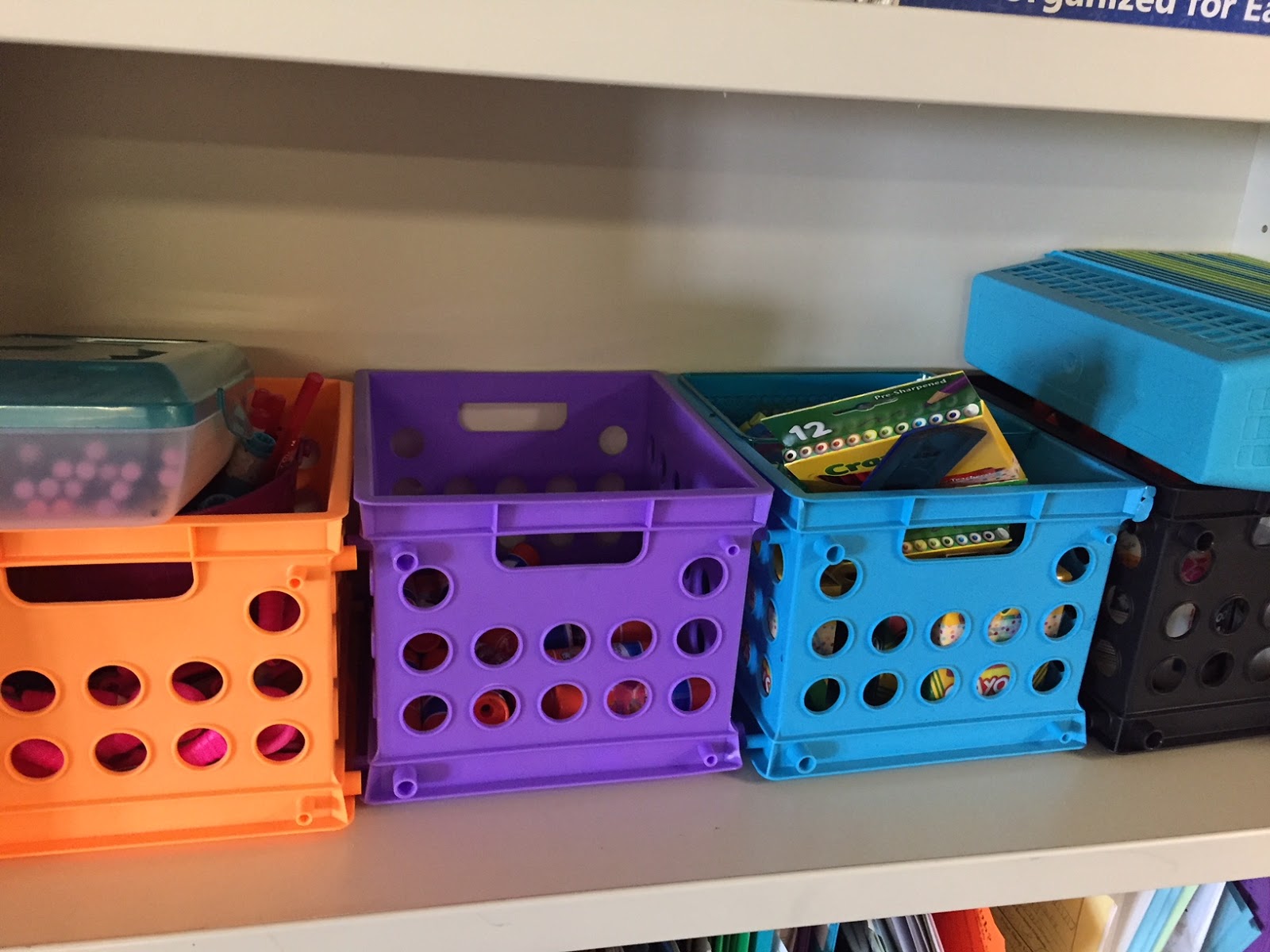
When someone needs a supply, they ask. I put the supply in a basket. The basket sits on their desk. When they're done with the supply, it goes back in the basket and back on my desk. This has mainly been used for glue sticks so far. Sometimes scissors, highlighters, crayons, etc. I'm slowly transitioning to having the students go to the shelf, get the supply they need, put it in the basket, and take it back to their seat instead of having me hand it to them.


I haven't lost anything yet and I think this isn't even about the supply: it's about awareness and the notion of "Oh hey, that's not mine. I should give it back."

I bought these baskets back in 2013 at Big Lots because I thought I might need them for my 2nd grade classroom. I never used them and they've been sitting in a tub ever since. I think I might've come up with this as, legitimately, just a reason to use the baskets.


3. Clip chart. I am the anti-fan of the clip chart but after the last year or the last two years, I've become anti-Class Dojo. I needed some kind of accountability in place because, again, you never know what kind of kids you're going to get. They are always very familiar with the clip chart system.


I use this clip chart mainly for rewarding positive behavior. When a student gets to the top of the chart (Super Student), I write it down on a spreadsheet. When they get to the top twice (not in a row, just cumulatively), they get a You Earned It! slip.


The most popular rewards are chromebook time (I let them sit and play while I teach and they love that) or picking from the prize box. I'm changing the rewards each quarter and this is what it looks like now:


My plan is to really whittle down what they want and give that to them. Kids will do anything if they know they can get what they want.

I think my whole point of this is that there needs to be individual accountability/reward and there needs to be whole-class accountability/reward and there's a very tricky balance between the two. This system, so far, works better than Class Dojo ever did and is only for individual behavior.

As for clipping down, I have Reflection Sheets. I'm not *as* on top of that as I should be. However, I will say that they get one warning, then one clip down, then it's a Reflection Sheet at the time-out desk. Asking students to clip down is 100% about sticking to my class rules and not letting things slide but it's also about picking your battles and being proactive. For example, I have some consistent, constant chair rockers. It drives me insane and then they fall out of their chair.  Does anyone have any advice on this? It's my biggest stumbling block right now.

4. Restroom Tickets.


This is something I made up in 2014. I started it in the fall, a few weeks after school began. In 2015 and in 2016, I didn't do it at the very beginning of the year because I had assumed that students had somehow been ingrained with that innate skill of self-regulation but no. I kept going back to it. This year, I started it right from day one. 
Students get two tickets each month. I use a different color for every month. They write their names on them and those tickets are their responsibility. When someone needs to leave the room for the restroom or a drink, they must use a ticket. They need to sign out and sign back in (a school rule, not mine...it wastes an enormous amount of time, in my opinion, because they're not good at reading clocks or writing quickly). 
The tickets are passed back out at the end of the day and it starts over again. I change the ticket color each month and this is for two reasons: 1. If someone lost a ticket at some point, they get a fresh start and 2. All old ticket colors are expired and can't be used so someone isn't getting 4 or 5 trips a day. 
I also posted the rules as a reminder right by the sign-out sheets. That was something I hadn't done in previous years. 

5. Teacher vs. Students
This is my whole-class accountability system. It's basically a tally of points on the board. Me vs. them. I hate that I have to do this but oh-em-gee...it works. I set timers for transitions and when I need them to do something that involves free will. Free will, in a classroom, can easily translate to someone running, someone shouting, someone notdoinganythingtheyaresupposedtodo. By setting and projecting the timer, they know how much time they have. Times stay the same. They always have two minutes to put away their Rocket Math folders and get out their Reading materials. They always have 5 minutes to unpack and sit down in the morning. For quick transitions, when I really want them to earn a point (you, as a teacher, can easily manipulate this system), I give them a minute when I know it'll only take 30 seconds. They need to be ready, quiet, and prepared when that timer goes off. If they are, they get a point. If they're not, I get a point. Points for them equals extra recess (however many more they have than me gets added on in the form of minutes), points for me equals extra math homework for them. 

6. Student-Centered Bulletin Board
I got idea that I really wanted to display more student work this year and wanted to make sure what they were doing was up in the classroom. The room should not be covered in anchor charts only. As a side note, I never, ever have enough wall space. I think a lot of people long for floor space or cupboard space...I just want more wall space. 

I did student "selfies" on this board for the first month of school (they drew a selfie and wrote in something that they were good at), I did a K-W-L chart about September 11th for a few weeks, and then I wanted to focus on the theme of perseverance. I found this pumpkin activity because I had two gaudy, glittery pumpkins that I didn't have a use for and the two fit together perfectly. Each day, two students get a blank pumpkin and a glittery pumpkin on their desk. They have to write in something they persevere at, color their pumpkin, and give it back to me. I display it and they also get to keep the novelty pumpkin on their desk for the rest of the day. 

This has really added to the community feel in the classroom and I like seeing what they come up with as the thing they persevere at. I figure this bulletin board can stay up until December and then I'll do something winter-related that can stay up until the end of January. I'm still looking for ideas. 

I think that's it for now. I'm really prone to trying new things often and writing in my planner when I want to implement them. Trying new things too often isn't productive so I try to space it all out. These are the winners from this first quarter of the school year so hopefully I'll have a few more winners to share later this semester!


August 22, 2017

Why I decided to use a clip chart (and get rid of Class Dojo)

This post is pretty specific to teachers, but it took me a lot of thinking and a major-ish revelation to make this switch. It was a big moment. I think it's worth sharing my thought process. I've been a HUGE proponent of Class Dojo for the last 4 years and I like it but I can't use it right now.

I've had great success with Class Dojo, and I wrote about how I don't like clip charts. However, this year, I decided to scrap Class Dojo and go back to a clip chart.

Why?

Lots of reasons.


1. Class Dojo was interrupting valuable instructional time. It was interrupting in two ways. First, I would have deal with swiping and scrolling and my iPad freezing when I was trying to teach. Picking up the iPad to give or take points mid-instruction would be time-consuming and/or stressful.  Secondly, parents would send messages that needed timely responses such as Can you please tell _____ to walk home with ______ after school? instead of calling the office to pass on the message. If I didn't check Class Dojo and respond, the message wouldn't make it. That was interrupting the flow of the classroom. I liked having an open line of communication but it would pull my focus away from what I was doing.


2. Kids were too focused on it. They wanted to know their percentages and their points, and I didn't always have time to give real feedback or explanations. When I gave or took points, they wanted to know who it was and, while that makes perfect sense, calling kids out for every little thing (good or bad) was wasting time and that's not necessarily the most valuable form of feedback. But not using it as regularly brought up questions about why I wasn't using it. It becomes a distraction to the class as a whole and I found myself hating the iPad and never, ever wanting to deal with it. Plus, if there's a substitute, it can be a difficult system to explain.

3. Parents were too focused on it. I found myself typing out long messages to justify points taken away and the constant defending was getting old. By not having reminders of their child's positive or negative behaviors tracked down to the minutiae, we can all just focus on the bigger picture. Parents are used to clip charts and none of the 5th grade teachers use Class Dojo, so I don't need to get these kids ready or prepared for it next year. The parents won't run into it, likely. Truth: I have files of saved conversations, just in case I need them to defend my actions in the future. While having textual evidence of what was said and when is great, I'm not a lawyer and I've spent far too much of my career carrying my iPad into an administrator's office, reading off quotes, in my defense.

I will still use Class Dojo for one thing:

1. The lessons. Class Dojo has amazing lessons on mindfulness, perseverance, and empathy. There's cute videos that the kids love and I really enjoy being able to teach interactively in a way that engages them. I pull in at least one series a month depending on what they'll benefit from the most. These can also be found on Youtube so I might go that route.

----------------------------------------------

I'll be happy to update this post on whether or not the clip chart actually works, as I haven't used one since 2013. However, I do know that I'm going to really attach a positive or negative consequence to each clip move. This isn't about being punitive or making up punishments. My initial thoughts...

Everyone starts on Ready to Learn.
A courtesy warning is given before any clip is moved down. The exception to this is if a specials' teacher tells me a student needs to clip down. They've likely already been given several warnings because specials' teachers are nice like that. 
One clip down is an official warning.
Two clips down is a reflection sheet at the time-out desk. If it continues past that, parents are notified.
To go the other way, students will be clipping up when they are complimented by other teachers or helpful to others. Being on-task and ready to learn in a way that is above expectations is also important. If I don't even have to ask them to get ready to do something, if they do it on their own, that's a clip up. In addition, showing empathy and consideration for the learning community as a whole are the skills I want to build up. I have a list of non-prize box rewards that they can choose from if they get to Super Student twice...things like computer time, art time, bring in a toy, sit on a stool instead of in their boring chair, etc. 
However, I will likely take a picture of the chart at the end of each day, in order to have that documentation. Since I'm using an emoji theme, they can draw the face they land on in their planner at the end of the day.

These are my mid-August ambitious pipe dreams anyway. Fingers crossed.

August 17, 2017

Classroom Stuff and Things 8/17

Thanks for the acknowledgement and positivity on Monday! It's a stressful season because it's all about change right now. We ran into a major hiccup shortly after I posted this and I started to wonder why I'd shared in the first place. Often times, things change before I can get an official blog post written about what we're doing next! Anyway, I think things are resolving and s l o w l y falling into place. Maybe. 
---------------------------------------------------------------------------

Because it wouldn't be a school year without classroom pictures....

True story: I took pictures last year, completely forgot to post them, and then all of a sudden I didn't care because I was bogged down with...stuff...and things.

Today is the third day of school for kids. This is what things looked like at the beginning of the week.

If you're like me, you love nothing more than looking at classroom pictures.


New things I'm trying:

A math word wall. I'm also going to be posting the vocabulary words for each chapter. I feel like that might help cement understanding.

Mailboxes. I've used them once in 8 years. This is my second go-around.

Hanging important info for kids at their eye-level.
Separate turn-in boxes for each subject.

A clip chart. I wrote a whole post about this. I'll get that published eventually. 

Overall, I'm hopeful. So far I'm at 28 students, and I do expect the number to go up. 
I've noticed that I have some very sweet and very quiet (and hardworking!) kids this year and I'm so grateful for that. Last year I only had a few that fit into that category, but I have gotten several visits from past students this week and, for that also, I'm grateful.
That's more or less the reason why I keep at this whole teaching thing.

If you have a classroom, I'd love to see your pictures!


And there's pictures from Missouri and other years in Colorado too on this blog, but it's early and I'm tired and I have other teacher-like things to do.


November 29, 2016

Why I stopped checking my work email at home.


I actually put this practice into place and had been mulling it over for a few weeks, and then Gretchen Rubin did a podcast episode about it. So I knew this was justifiable and I probably need to tell everyone about it in order to hold myself accountable. 
These are the reasons why I stopped checking my work email at home AND I deleted the app for it from my phone:

1. I'm not on-call. This is the biggest reason. I work 7:45am-3:45pm. I am not obligated to anything other than that. I spend time most weekends grading papers or writing plans. Or in the morning before work, grading papers. Or at night, grading papers. All teachers do these things and I'm okay with that to an extent. It can't all get done at school; there's not enough time. But I am not going to be on-call for parent questions or updates about what's happening the next day from coworkers/admin during my off hours. There is nothing that can't wait until the next morning.
Sometimes I do allow myself to check my work email on Monday when I wake up and check my regular email, just because it's nice to know what I'm walking into.


2. It was giving me anxiety. So I would get these emails in the evening. And then I would fret. And I would worry. And I would commiserate and complain with coworkers via text. And it would literally overtake my evening (not that I was doing anything other than watching Jane the Virgin, but still). I don't need that kind of pressure. In this case, ignorance is bliss. I can't do anything about it at 7pm anyway.

3. Weekends are for things unrelated to work. They just are. It didn't bother me quite so much when Scott was deployed and I spent a lot of time doing schoolwork on the weekends and was okay with that. Last year, it wasn't an issue anyway. This year is...different. Something had to be done in order for me to maintain sanity. Therefore, I stopped checking work email at home around the end of October.

4. Most people don't reply on the weekend anyway. Not because they have a personal policy against it (hello there), but because they're just busy with other things. So, me doing business on the weekend wasn't actually getting me anywhere.

What about you? Are you willing to *work* on the weekends?

June 28, 2016

Pinterest Tricks That (Really) Do Work in the Classroom


These are things I have used and will continue to use. I found them on Pinterest (clearly), so the links will take you to the pins.


This list of Beginning of the Year Procedures, so you don't forget to go over something. Checklists are great for that first week.


This Non-Fiction Notes strategy. I don't have it made into an anchor chart, but I have it on a piece of paper I project and the students copy it down. I should make it into a form for this coming year...
I use it for articles, partner-reading, and videos. You can give any video a purpose by making them accountable for completing this task at the end. Sometimes BrainPop can just explain it better than I can, you know?


What Does My Grade Mean?  I've made this into a handout for parents and students and also have one to project on the board as I hand back tests. Kids always want As (uh, so do the parents) but sometimes they (students and parents) don't get that a B or C is fine, because learning is the goal. Anyway, we still do letter grades in 4th and 5th grade in my district but it's a jump from the standards-based grades that they are used to in the primary grades. This is a handy explanation.


I love this colorful bulletin board display. It's perfect for hanging work and anchor charts and easy to change things out often. I would HIGHLY recommend making one if you have the wall space. The picture of mine is in the graphic at the top of the post.


For Open House/Meet the Teacher Night, I used cardboard boxes with labels to have the kids sort their own supplies. It was amazing. Here's a picture of mine.


I used this substitute form when I taught 2nd grade. Currently, my district provides one for the sub so I don't make them fill out two.


I did this highlighter trick next to the turn-in box. It worked two years ago, and didn't work well with this last group I had. I'll probably try it again this coming year.


I did this math trick with 4th graders. It works well with inquisitive kids.


And Flocabulary has some very engaging songs/videos for older kids. I did not find this on Pinterest, but I pinned it.

June 21, 2016

Why I wouldn't use these Pinterest "tricks" in my classroom


First, the clip chart. I don't like clip charts and I don't use them. I could write an entire chapter on the "why" of this, but to keep it short: they didn't work for me. 

1. Every time a student does something good or not good, you tell them to clip up or clip down. That is dozens of times a day you are breaking instruction or pausing in your train of thought to tell a student to clip up or clip down. 

2. These students are getting up out of their seats, breaking their path of learning, to clip up or clip down. It's distracting for everyone. 

I took a class a few months ago and someone suggested a clip chart as a great method of student accountability and everyone ooed and awed and I thought Is this 2006? 

I feel like this paper plate version would fall apart by mid-September, especially if the students are the ones moving the clips. 


I really do have many thoughts on management systems because I've used some really bad ones and some really good ones. It's trial and error every year with each new group of kids. But I will be elaborating on this in the future. 

----------------------------------------------------------------------

I can't even with this. Maybe in a center-based learning primary school. Maybe in preschool. I can't even imagine what would happen if I set something like this up (if I were allowed to...I wouldn't be allowed to).

---------------------------------------------------------------------------


I have a homework folder system too. It does not look like this. 
I would like to know who has the wall space for this kind of system. It looks like they probably have 30 folders up there. I could think of 30 other things to use that space for. Also, how are they attached? I feel like they would fall down. 

---------------------------------------------------------

Speaking of homework turn-in, I'm all about listing reminders next to the turn-in tray. However, if you put your reminder on the bottom of the tray, the only student who sees it will be the first one to turn in their work. The first one to turn in their work either doesn't need the reminders because they are incredibly on top of things, or they rushed through it and won't read the reminders anyway. It's like a law of physics. 


As for the clip part (what is it with teachers and clips?), I've never tried it. I initially think it may only work if you're doing one assignment turned in at a time, but maybe you could tweak it to work for you. You'd have to train the kids well, though, on how to use it. 

And we need to consider that the source of the above picture is Buzzfeed (worthless.com when it comes to teaching ideas) and the source of the idea is photobucket. I give that the side-eye. 

But I have seen this in classrooms before, so maybe it does work?

--------------------------------------------

Obviously, what I've been doing with my spare time is perusing Pinterest and picking out all of the stuff I would never do or use. Stay tuned for a list of Pinterest tricks I would definitely use! I've been writing Pinned It/Did It posts for years now anyway.